|
|

|
|


MICROPHONES
Microphones are transducers that convert acoustic energy to an electrical signal. They each employ different mechanisms to achieve this. It’s important to select the right type for the recording situation you are facing.
There are five types of microphone currently available.
CRYSTAL
These mics utilise a diaphragm, coupled to a peizo crystal made of quartz or barium titanate. The bending of the crystal in response to an acoustic sound wave produces a proportional voltage at the output. Crystal microphones produce a limited frequency response without lows or highs and work great for telephones and harmonicas. They require no power to work. Not seen much outside of a harmonica player’s bag!
DYNAMIC / MOVING COIL
In these microphones, the diaphragm is coupled to a coil of copper wire suspended in a magnetic field. The pressure variations move the coil within the field producing a voltage at the output. Dynamic microphones are durable and especially good for close mic situations, for example vocals. They do not suffer with the bass proximity effect of some other types and respond quite well to transients (peaks). Good for kick drums and bass. They require no power to work.
CONDENSER / CAPACITOR
This time, the diaphragm is made of a precious metal, gold or some exotic alloy, is charged with a voltage, usually 48 volts DC phantom power and held close to a rigid metal back plate that is electrically earthed. Pressure variations move these incredibly thin diaphragms in respect to the back plate producing a change in voltage. The signal is then amplified with a built-in pre-amp that produces a top quality sound for audio recording. These mics require power.
Originally these pre-amps used valves or vacuum tubes to boost the signal. These were replaced by transistor technology in the 60's. The signal was cleaner with less noise and a better top end (high frequency). With current digital technology, there is a move back to valves as they are perceived to be warmer sounding and because valves tend to distort in a sweeter manner. This is called soft clipping and helps to offset the perceived coldness of digital recording. Having said that, modern valce mics seem to be getting brighter and brighter, a trend I am not enjoying. Condenser Mics are the job for vocals, whether valve or transistor is up to you. I have had success with both. My favourites include mics by Neumann, Telefunken, AKG and Sanken. Even if you can't afford one of these for everyday, consider hiring one for a vocal session along with a good optical compressor.....it really does make a huge difference!!
NB: These mics do suffer with the bass proximity effect so need a good ‘pop’ shield to avoid low frequency thumps and bumps!
ELECTRET
These are similar to condenser mics except that a permanent electrostatic charge is applied to the rigid back plate. No power is needed for the diaphragm, however an internal pre-amp needs power from a battery or 48volt phantom. Very good for high frequencies, cymbals, hi-hats. etc. I have found a pair of Shure SM81's can be very nice as overheads on the kit. The PZM or Pressure Zone Microphone is also an Electret microphone althogh can be referred to as a Boundary Microphone. It is mounted a few thousandths of an inch away from a boundary plate, ie., the pressure zone. We usually gaffa tape these to a flat surface like a wall or window. I have had some success mounting these on the floor near a drum kit or on the lid of a piano so that I can close the lid to reduce spill from other instruments. Not my favourite 'go to' mic as I can usually hear odd phase stuff going on that I don't like.
RIBBON / VELOCITY
Instead of a diaphragm, these mics employ a ‘ribbon’ of conductive foil placed between two fixed magnets. The pressure variations move the foil within the field producing a voltage at the output. They have no pre-amps but employ a transformer to help boost the output signal. Very fragile, good for acoustic instruments. They do not require power and in fact can be damaged by connecting to 48 volts phantom. Never blow directly into these mics.
DIRECTIONAL PROPERTIES
All microphones can be described as having a sensitivity to acoustical energy from various directions. Some mics pick up sound evenly from all directions. Others pick up sound in a more focussed manner in the direction the capsule is pointed. The are three categories of directionality.
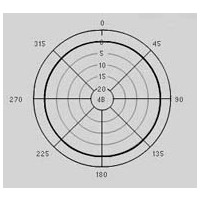
OMNIDIRECTIONAL – All directions evenly in frequency and gain. These mics are good in situations where leakage or spill from other instruments is not an issue. A spaced pair of omni microphones can capture an orchestra in a very natural way. These mics have a Directional Pattern or Polar Pattern as shown here:
|
|
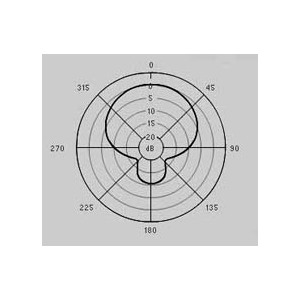
UNIDIRECTIONAL – Focused in one direction with a fall-off in bandwidth in opposed directions. Bandwidth is a description of the width of frequencies measured in Hertz. Mics in this category are said to be Cardioid, Hypercardioid or Supercardioid. These mics are general purpose and used in most recording situations. They are versatile for live sound too, helping to avoid feedback etc. The Polar Pattern for this mic is heart shaped, hence Cardioid…see here:
|
|
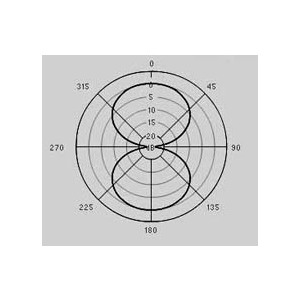
BIDIRECTIONAL – Picks up sound focused in two opposite directions. Not a very popular or useful category. If you are short on mics you can place one of these between two sound sources and pick up both….a pair of rack toms for example. The Polar Pattern for this mic is said to be Figure of Eight….see here:
|
|
Some professional condenser microphones allow you to adjust the Polar Pattern and therefore the directional properties on the mic or remotely on the power supply if powered separately. This is of great benefit. You can choose Omni, Cardioid or Figure of Eight as needed.
DI’s (Direct Input / Direct Interface)
These come in two varieties, passive or active. Either will allow you to connect a 1/4” jack plug from an electric guitar or bass through the DI box and then to the Desk mic input or pre-amp mic input using a balanced XLR cable.
Passive types
The passive models utilise a transformer to match a high impedance input to a low impedance output. Usually there is a ‘ground lift’ switch to reduce hum if necessary and pad switch to cater for different source levels. They require no power.
Active types
The Active models employs a pre-amp which can provide gain and are much more versatile. These do require power, 48 volts phantom or batteries. These often have a second ‘thru jack’ which can be fed to your tuner. Again pad switches to control source level and ground lifts are the norm.
In the case of keyboards, drum machines, etc., you will need at least two DI boxes. Start with the pad switches in the –20db positions, as the input level may be ‘hot’ from these devices. If any of your devices have balanced outputs ie., XLR’s, you may plug these directly into the Line Inputs on your desk or pre-amp. I recommend having six or eight of DI boxes for both studio and live recordings. The ‘thru jacks’ can feed the amplifiers in the normal way without interfering with the performers usual set-up.
A useful link to all things 'Microphone' can be found here:
http://recordinghacks.com/microphones
|
|